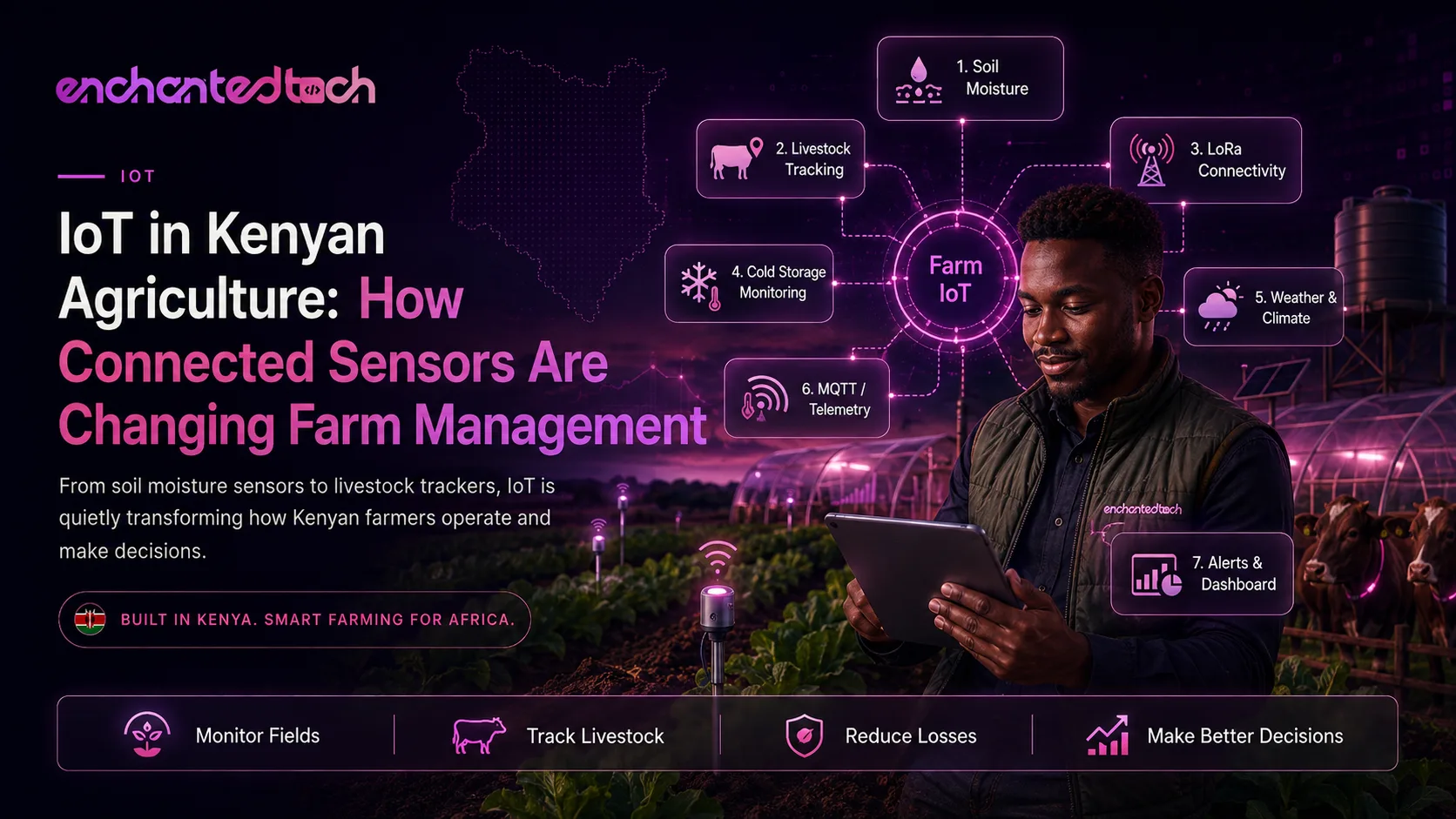
Agriculture in Kenya Is Going Digital
Agriculture employs nearly 40% of Kenya's population and contributes around 25% of GDP. Yet most farms still rely on manual record-keeping, paper logs, and gut-feel decision-making. The cost of this is measured in spoilage, inefficiency, and income lost to problems that could have been caught earlier.
IoT — the Internet of Things — is changing this. Connected sensors that measure soil moisture, temperature, livestock movement, and equipment status are now affordable, durable, and increasingly within reach for medium and large Kenyan farms. Here's what's possible.
What IoT Actually Means for a Farm
IoT on a farm means attaching small, low-power sensors to physical things — soil, water tanks, livestock, machinery, storage facilities — and having those sensors transmit data wirelessly to a central system. That data is then visible on a phone or dashboard, triggering alerts when something is wrong, and building a historical record that informs better decisions.
It's not science fiction. The components are available in Kenya, and the connectivity challenge — often cited as a barrier — has practical solutions.
The Connectivity Challenge (and How to Solve It)
The first objection is always: 'But there's no reliable internet in my farm area.' This is where LoRaWAN technology changes the game. LoRa (Long Range) radio can transmit sensor data across several kilometres with minimal power consumption — no Safaricom data connection required. A single LoRa gateway installed on the farm can receive data from dozens of sensors spread across hundreds of acres.
For larger farms with infrastructure, MQTT over cellular (4G/LTE) provides real-time telemetry that can feed into a centralised dashboard accessible from anywhere.
Soil and Crop Monitoring
Soil moisture sensors placed at root depth tell you exactly when irrigation is needed — not based on schedule, but based on actual soil conditions. This reduces water waste by 30–50% in most deployments. Temperature and humidity sensors in greenhouses trigger ventilation systems automatically. pH sensors alert when soil acidity changes. Light sensors track photosynthesis conditions.
Combined with weather data integration, these sensors give a farm manager a real-time picture of field conditions without walking every acre.
Livestock Tracking
GPS collars and ear tags on cattle, goats, and other livestock provide real-time location data. Geofencing means you get an alert the moment an animal leaves the designated grazing area. Activity sensors detect unusual movement patterns that may indicate illness, distress, or predator proximity. Weight sensors at feeding stations track individual animal health over time.
Cold Chain and Storage Monitoring
For produce farms, cold chain integrity is everything. Temperature sensors in cold stores, delivery vehicles, and packing areas send alerts when temperature goes out of acceptable range. This prevents spoilage and gives farm managers time to act before an entire batch is lost.
The Farmly Connection
Our Farmly platform — currently in active development — integrates with IoT sensor data to give farm managers a unified view of operations: sensor readings, inventory, task management, revenue tracking, and team coordination in one system. The goal is not just to collect data, but to make it actionable for non-technical farm managers.
Getting Started: What a Basic IoT Farm Setup Looks Like
Start with a specific problem: water waste, livestock theft, or produce spoilage.
Identify the sensors needed for that problem.
Choose a connectivity method: LoRa for remote areas, MQTT/4G for connected farms.
Build or deploy a simple dashboard to visualise the data.
Add alerts for threshold breaches.
Expand from there once you've proven value on one problem.
The biggest mistake farms make with IoT is trying to monitor everything at once. Start with one high-value problem and build out from there.
→ Talk to us about IoT for your farm or agribusiness — enchanted-tech.com