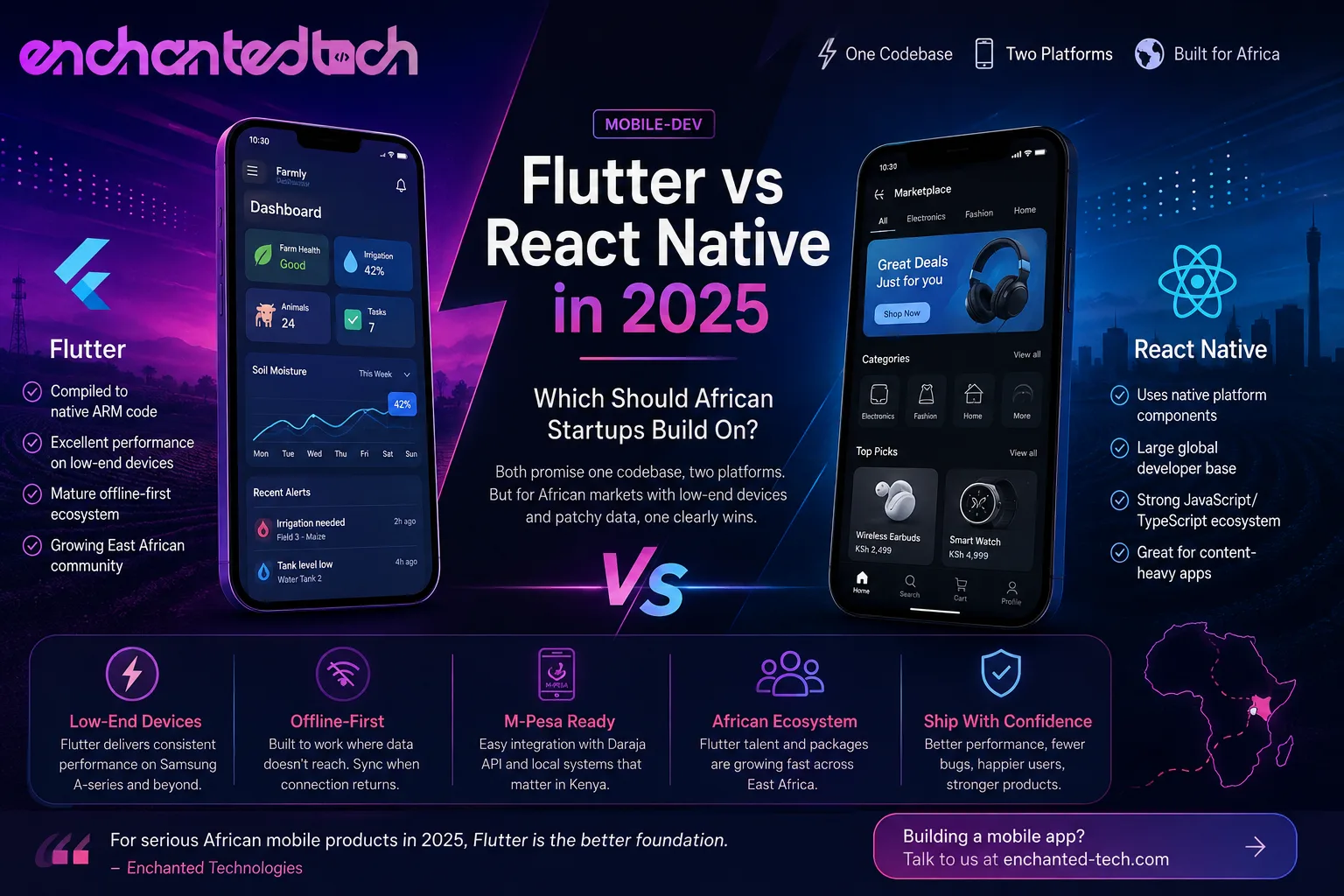
The Cross-Platform Debate, Africa Edition
Most Flutter vs React Native comparisons are written for Silicon Valley startups building social apps for high-end iPhones. That's not the African context. Here, we're building for Samsung A-series devices, intermittent data, M-Pesa integration, offline-first requirements, and field workers who may have never used a smartphone app before.
The framework choice matters more in this context, not less. Here's our honest breakdown after building both at Enchanted Technologies.
The Basics: What Each Framework Actually Is
Flutter
Flutter is Google's UI toolkit that compiles to native ARM code. It ships its own rendering engine (Skia / Impeller), which means it draws every pixel itself rather than relying on native UI components. Built with Dart.
React Native
React Native is Meta's framework that uses JavaScript to bridge to native platform components. It uses the actual iOS and Android UI components, which means your app looks and feels like a native platform app by default. Built with JavaScript/TypeScript.
Performance in Low-Resource Environments
This is where Flutter wins decisively for African markets. Because Flutter compiles to native ARM code and controls its own rendering, it performs consistently well even on entry-level Android devices. The Impeller rendering engine (Flutter's next-gen renderer) is particularly smooth.
React Native's JavaScript bridge has historically been a performance bottleneck. The new Architecture (Fabric + JSI) helps significantly, but it's still more complex to optimise on low-end hardware. For apps that need smooth animations, real-time data updates, or heavy list rendering on a Samsung A03, Flutter is the safer bet.
Offline-First Capability
Offline-first is not optional in Kenya. Field agents go underground, farmers work in areas with no signal, hospital systems must function during network outages. Both frameworks support offline through local databases, but Flutter's ecosystem (Hive, Drift, ObjectBox) is more mature and better documented for complex offline sync scenarios.
Our Farmly farm management application is built in Flutter specifically because farmers work in remote areas. The entire app functions offline, with sync happening when connectivity is restored. This kind of architecture is far easier to implement robustly in Flutter.
M-Pesa and Local Integrations
Both frameworks can integrate with M-Pesa's Daraja API — it's just REST calls. But the Flutter community in East Africa is growing faster. There are more Kenya-specific Flutter packages, more local developers who know the ecosystem, and more documented examples of integrations with KRA, M-Pesa, Safaricom APIs, and government systems.
Developer Ecosystem in Kenya
React Native developers are more abundant globally, which keeps hiring costs lower if you're building an international product. But in Nairobi specifically, Flutter talent has grown rapidly. Google's investment in Flutter training in Africa, combined with the Dart language being relatively easy to learn, means you can build a strong local team.
Dart has a learning curve coming from JavaScript, but once a developer crosses it, productivity is high. The strict typing and structured widget tree actually reduce bugs in production — important when your team is small.
The Cases Where React Native Wins
You have an existing JavaScript/TypeScript team and don't want to invest in Dart learning.
You're building a content-heavy app where platform-native components (navigation, lists, forms) are the primary UI.
You need very deep integration with native platform-specific features (some niche iOS APIs are better supported in React Native first).
Your app is primarily a wrapper around a web experience — React Native's web compatibility is excellent.
Our Verdict for African Startups
For greenfield mobile products in the African market — especially anything that needs to perform well on mid-range Android devices, work offline, or serve field-based users — Flutter is the right choice in 2025.
React Native is a perfectly good framework. But Flutter's performance consistency, Dart's safety, and the growing East African ecosystem make it the better foundation for serious African mobile products.
At Enchanted Technologies, Flutter is our default for all new mobile projects. We've built on React Native and we respect it — but we ship better products faster on Flutter.
→ Building a mobile app? Talk to us at enchanted-tech.com